Taking a look at some
of the most important news events that have shaped India in the decade gone by.

Two of the world's largest-ever democratic
elections with a turnout of nearly 2 billion people, dozens of other assemblies
or state elections - some simultaneous, while most within a few months of each
other; giant leaps forward in our space program, some of the biggest and most
significant reforms since independence, strategic shifts in the defense and
foreign policies, some landmark judgments by the Supreme Court, revamping the
railways, building highways at never-before speeds, massive infrastructure work
at various levels, the entire nation becoming one market, taking a lead in
addressing issues relating to climate change, winning a world cup, and
attempting to make Mahatma Gandhi's vision a reality - a lot has happened in
India in the decade gone by.
1.Narendra Modi And The General Elections Of 2014 And 2019:
While
the Congress led-UPA-2 was plagued with allegations of corruption and scams
whilst also facing problems like severe policy paralysis, the BJP nominated
Narendra Modi - the three-time Chief Minister of Gujarat whose state was a top
performer - as its prime ministerial candidate. The BJP's election campaign
titled "Abki bar, Modi sarkar" (This time, Modi's government) went on
overdrive highlighting how Narendra Modi was a bold and effective administrator
who has delivered consistently in Gujarat? He promised the people of India
"achhe din" or better days. He also stressed on his slogan
"sab ka saath, sab ka Vikas" (For everyone, and development for all).
The campaign was hugely successful. Narendra Modi became a household name
across India, such that many termed it as a "Modi wave" across the
nation. The mandate was overwhelmingly in his favor, and Mr. Modi delivered the
BJP's best ever results till then, giving it comfortably more than the 272 seats
it needed to get a full majority. This became the first parliamentary majority
by a single party since 1984. With its allies, the BJP in 2014 had over 300 of
the 543 parliamentary seats.

The stunning numbers provide incontrovertible
evidence of the "Modi wave" which was much talked about. Narendra
Modi became Prime Minister of India.
Five
years went by and the Modi government delivered on several promises. While
there were some complaints, the BJP-led NDA government got more things right
than it did wrong. Prime Minister Modi led from the front and delivered on
several counts. His party - the BJP - also maintained the pressure on the
opposition Congress, keeping them mostly on the back-foot. As the 2019 general
election approached, Prime Minister Narendra Modi and the BJP seemed to have a
clear advantage. The question most people asked was "Modi vs who?"
The
2019 election result was declared in May, and the "Modi wave" became
a "tsunami", or as some called it "TsuNaMo". The BJP got
more than 300 seats by itself and crossed the 350-mark with its allies in the
NDA. The Rahul Gandhi-led Congress barely crossed 50. It has been little over
six months since the second term of the Modi government began and it has
already gone into top gear. However, some of its recent decisions have led to
protests across the country. How things play out over the next four-and-a-half
years is anybody's guess, but it is a crucial period for India - a period that
will decide if India, the youngest country in the world in terms of the average age
of the population, will end up being a demographic dividend or a demographic
disaster. A lot rides on Prime Minister Narendra Modi and his decisions.
2. Demonetisation Or As Many Called It, 'Notes Ban':
On November 8, 2016, Prime Minister Narendra
Modi addressed the nation at 8 pm. The announcement made the entire nation stop
what they were doing and look at the nearest available television set. The 500
and 1,000-rupee currency notes were declared illegal tender, or in simpler
words scrapped - of no value. The people were assured that their money was safe
and all they needed to do was to deposit whatever cash they had in their bank
accounts by December 30 the same year.
Till that date, people could only
withdraw Rs 24,000 per week, including a maximum of Rs 2,500 from ATMs per day.
The aim was to "end black money". Black money is money that is either
unaccounted, untaxed, or illegal. By declaring and depositing whatever cash
people had with them, the money would end up being accounted for and taxed,
thereby bringing a sudden end to the shadow economy.
The government also announced that anyone who has undeclared wealth in the form of cash
can pay the legit tax on it.
3.GST - India's Biggest Reform Since Independence:
On
July 1, 2017, at the stroke of the midnight hour, when the world slept, India's
parliament launched the historic Goods and Services Tax or GST, unifying India
as "one nation, one tax, one market", ending dozens of state taxes
and levies and bringing goods and services with a common tax slab across the
nation. The step not only helps reduce paperwork and helps logistics but also
curbs corruption and makes it easier for both domestic and foreign businesses.
By implementing the GST, India unified it's over the two-trillion-dollar economy and
more than 1.3 billion people into a common market. Goods and Services of a
common type now cost the same in all states and union territories.

The
biggest game changer in GST is input tax credit, where credits of input taxes
paid at each stage of production or service delivery can be availed in the
succeeding stages of value addition. This means that the end consumer only
bears the GST charged by the last point in supply chain, with set-off benefits
at all the earlier stages.
The
GST is seen as a measure that will reap benefits in the long run.While Prime
Minister Narendra Modi and many in his government are convinced that
demonetization was a big success, critics and the opposition parties firmly
believe otherwise. Leaders like Rahul Gandhi, Mamata Banerjee, and several other
senior politicians, some of whom were even formerly associated with the BJP,
have been very critical of the government's notes ban move. However, if
elections are an indicator of whose argument the people believe, the 2017 Uttar
Pradesh assembly election, which were held shortly after the demonetization
move, gave a massive mandate favoring PM Modi's party, the BJP.
4.India's World Cup Win:
India
became the first home nation to win a World Cup when they defeated Sri Lanka in
the final at the iconic Wankhede Stadium in Mumbai. It was an emotional journey
for India as it was Sachin Tendulkar's final appearance in cricket's biggest
extravaganza. Sri Lanka won the toss and Mahela Jayawardene's unbeaten 103 took
the islanders to 274/6 in 50 overs. India was in trouble when they lost both
Sachin and Sehwag at 31/2. But it was for the 109-run stand between captain MS
Dhoni (91 not out) and Gautam Gambhir (97) took India to the cusp of
victory before MS Dhoni and Yuvraj Singh finished it off.

With victory at an
arms distance, Yuvraj Singh at the other end, and eleven balls to spare MS
Dhoni went for the kill - a huge six into the dark Mumbai sky, as Wankhede went
from sudden silence to a roar in a nanosecond. India celebrated through the
night, people and flags everywhere, with random hugs and tears of joy, cricket
had united the nation once more. As for MS Dhoni, of all the things the great
leader will be remembered for, that six is definitely the most lasting memory
for all cricket lovers who have followed and idolized him over the years. That
shot has made him immortal.
5. Ayodhya, Disputed No More:
In what is believed to be one of the longest
court cases globally, the Supreme Court delivered its verdict in the Ram
Janmabhoomi-Babri Masjid land dispute case in November 2019. The disputed land
in Ayodhya belongs entirely to the deity Ram Lalla or infant Lord Ram, the
Supreme Court said in a landmark verdict that paves the way for a temple at the
site claimed by both Hindus and Muslims for decades. A five-judge constitution
bench also ruled that a "prominent site" in the holy town in Uttar
Pradesh will be allotted for a new mosque.

The Ayodhya verdict came after a
century-old legal wrangle over the land where the 16th-century Babri mosque
stood before it was razed in 1992 by Hindu activists who believe it is the
birthplace of Lord Ram. In the riots that followed, more than 2,000 people were
killed. In their verdict, the judges referred to a report by the Archeological
Survey of India (ASI), which they said confirmed that a structure existed
underneath the mosque but did not specify whether it was a temple. Earlier, an
Allahabad High Court verdict prescribing a three-way division of the disputed
land in September 2010 failed to satisfy the Sunni Waqf Board, the Nirmohi
Akhara and Ram Lalla, the parties involved in the dispute. All three moved the
Supreme Court. The dispute has now been settled by the Supreme Court, and the
principal parties involved have accepted the top court's verdict. "It is
time for healing. It is big relief that we did our duty entrusted on us,"
one of the judges told NDTV on the day of the verdict.
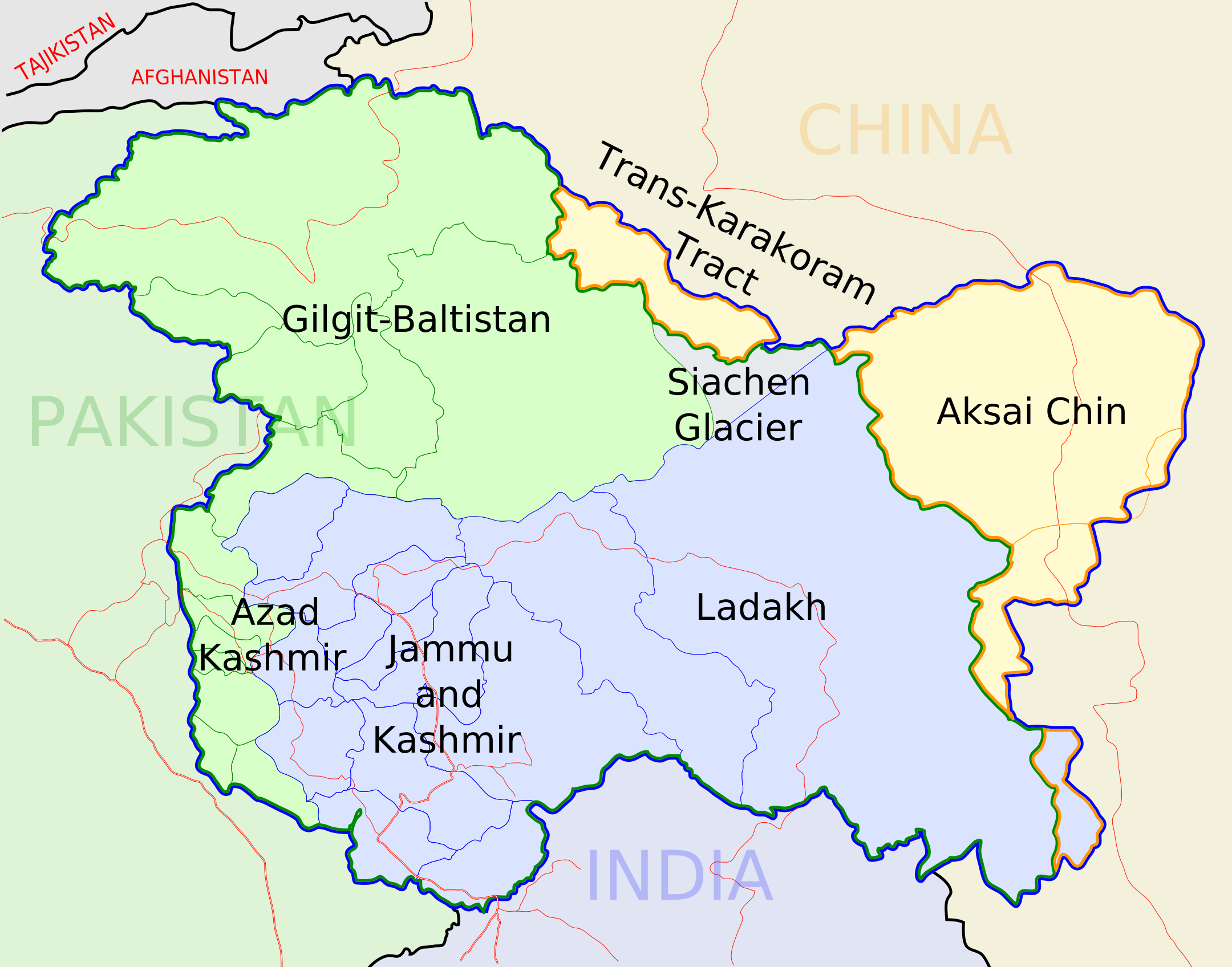
6. Jammu and Kashmir Fully Integrated, Article 370 Revoked:
The
"temporary" special status to Jammu and Kashmir under Article 370 of
the Constitution of India was removed by a presidential order that came into
force "at once", Home Minister Amit Shah said in parliament on August
5. The announcement came after Prime Minister Narendra Modi held a meeting of
his cabinet at his house the same morning. Jammu and Kashmir was also
"reorganized," with the state's bifurcation into two union
territories, Jammu and Kashmir and Ladakh - which came into being on October
31, 2019. The "temporary" Article 370 gave Jammu and Kashmir its own
constitution and decision-making rights for all matters barring
defense,
communications and foreign affairs.
Article 370 made it necessary for the
center to get the state legislature's approval for introducing any policies or
constitutional powers to the state. With the removal of Article 370, the
government says it will be able to develop Jammu and Kashmir at a much faster
pace, ensure that the rights enjoyed by the rest of the country are extended to
the residents of the two union territories. The government says it will also be
able to tackle the Pakistan-backed terrorism in the two union territories. The
Home Minister has assured that when the time is right, Jammu and Kashmir will
be made a state again, however, Ladakh will remain a union territory.
7. India's Space Missions: Mars, Moon, And More:
In
September 2014 ISRO made history when India became the first country in the
world to reach Mars in its maiden attempt. Not only was it a remarkable
achievement by India's scientists, it was so cost-effective that the whole
world was awestruck by it. The Mars Orbiter Mission was achieved on a budget of
$74 million, nearly a tenth of the amount the US space agency NASA spent on
sending the Maven spacecraft to Mars. "We have gone beyond the boundaries
of imagination," PM Modi said, applauding the extraordinary achievement.
With
Mangalyaan in martian orbit, India now set its eyes on another world record a
few years later - of launching over a hundred satellites onboard a single
rocket. In February 2017, the PSLV-C37 carrying 104 satellites was launched
from the First Launch Pad of Satish Dhawan Space Centre in Andhra Pradesh's
Sriharikota at 09:28 IST. In about 18 minutes, all 104 satellites were released
into space, each traveling at the speed of over 27,000 km per hour - 40 times
the speed of an average passenger airline. The mission was a big success and
received a lot of attention globally.

All
eyes we now set on India's second mission to the Moon. Named after its
predecessor, the Chandrayaan-2 was launched in July 2019. Unlike Chandrayaan-1,
which only had an orbiter, this time ISRO sent a lander named 'Vikram' and a
rover named 'Pragyan'. It would be the first time India's space agency was
attempting a soft-landing on the Moon. Things however, did not go quite as
planned by the scientists and the mission was only a partial success. While the
orbiter performs flawlessly from its lunar orbit, the lander and the rover were
lost as the craft made a hard-landing on the Moon. Determined to land on the
Moon, ISRO has hinted a another mission to the Moon in the near future.
8. Landmark Judgements By The Supreme Court: The country's top court has delivered some key judgments in the
last ten years, especially in the second half of the decade. Here are some of
them:

- Sabarimala Verdict: Women of all ages must be allowed in Kerala's renowned
Sabarimala temple, the Supreme Court ordered in September 2018, ending a
ban that prevented women and girls between 10 and 50 years from entering the shrine that draws millions of pilgrims every year. "Restrictions
can't be treated as essential religious practice," the top court said in a majority four-one judgment, calling the custom "almost like untouchability". The only woman on the five-judge constitution bench,
Justice Indu Malhotra, dissented, saying the court should not interfere in religious practices. For decades, women of menstrual age were restricted from entering the temple as its presiding deity, Lord Ayyappa, is considered to be a celibate. The hilltop temple remains open only for 127
days in a year and can be accessed through a forest. The review petition was filed, and the Supreme Court in 2019 agreed to a hearing in which it said that a larger 7-judge bench will look into the matter. The Supreme
Court also said that the larger bench should frame parameters to deal with
alleged discrimination against Muslim and Parsi women -- the entry of Muslim women into mosques and ''dargah'' as also Parsi women, married to non-Parsi men, being barred from the holy fireplace of an Agri.
- Triple Talaq Verdict: In August
2017, the country's top court banned the controversial Islamic practice
that allows men to leave their wives immediately by stating
"talaq" (divorce) three times, calling the practice
"unconstitutional". The verdict vindicated the stand of the government, which had said triple talaq violates the fundamental rights of women. Several Muslim women who have been divorced because of it,
including on Skype and on WhatsApp, had appealed to the top court to end the practice. The verdict was delivered by a panel of five judges from
different major faiths - Hinduism, Christianity, Islam, Sikhism and
Zoroastrianism.
9. Nirbhaya Gang-Raped, India Outraged:
On
December 16, 2012, a physiotherapy student and her friend climbed onto a bus in
south Delhi, assured by the driver that they would be dropped off at their
destination. The woman was gang-raped by six men for hours, brutalized with an
iron rod and her intestines were pulled out. She died in a Singapore hospital
13 days later, leaving millions in shock. Amid outrage and street protests not
just in India but also in other parts of the world, four of the rapists were
sentenced to death by a trial court in 2013. A year later, the high court
confirmed it. But Akshay Thakur, Vinay Sharma, Pawan Gupta and Mukesh moved the
Supreme Court for mercy. Ram Singh, the bus driver, was found hanging in his
cell in Tihar jail in March 2013, months before the rapists were convicted. The
sixth convict was just short of 18 when he was arrested. He walked out of a
correction home in December 2015 after spending three years - the maximum
punishment for minors - sparking public outrage and an overhaul of the juvenile
law.
The
four other convicts named above will hang, the Supreme Court has said, when
though, is not known yet. Nirbhaya's parents still wait as the decade draws to a
close.
10. Verdict on Section 377:
Consensual
Homosexual Sex Between Adults: Homosexuality is not a crime in India anymore
and it is not a mental disorder, five Supreme Court judges declared in
September 2018 in a spectacular leap for gay rights in the country and a
rainbow moment in its history. The Supreme Court overruled its own 2013
decision and partially struck down Section 377, a controversial British-era law
that banned consensual gay sex. The ban is irrational, indefensible and
manifestly arbitrary, the judges said. "Take me as I am," said the
then Chief Justice of India Dipak Misra, toasting gay pride. "We have to
bid adieu to prejudices and empower all citizens," said then Chief Justice
Misra, reading out what he said was a consensus judgment. The judges also said:
"Any discrimination on the basis of sexuality amounts to a violation of
fundamental rights". The verdict was cheered by millions across the
country, far beyond the gay community, which has fought for decades for the
right to be treated equally.
ISRO
has also announced its plans for future mission, including India's first
indigenous manned mission to space in 2022. The mission has been named
'Gaganyaan'. India's space plans also includes a second missions to Mars, a
mission to Venus and a mission to the study the Sun from as close as possible.
There are also reports claiming that ISRO is considering a mission to Jupiter,
however there is no confirmation in this regard.

Comments
Post a Comment